Showing posts with label projects. Show all posts

Sunday, January 9, 2011

Project VIII: Tree-Blogging. The Trunk

Use this material to begin branching out.  While the trunk material has a "tree and nature" theme, your work need not.

Sound:

  68391 Ohrwurm Chainsaw Tree cases by Bungy32

[Copyright free, Creative Commons sound file.  WAVE version and attribution information available here.  MP3 download available here.]


  65883 Benboncan Woodpeckers Pecking 2 by Bungy32

[Copyright free, Creative Commons sound file.  WAVE version and attribution information available here.  MP3 download available here.]

Images:


Text:


The Remix Tree

When you add a sample which is a remix of another sample, it will appear in this tree...Remixed samples appear as branches in the tree.  (The Freesound Project)


"The Big Trees"

So far as I am able to see at present only fire and the ax threaten the existence of these noblest of God's trees.  In Nature's keeping they are safe, but through the agency of man destruction is making rapid progress, while in the work of protection only a good beginning has been made.  (John Muir, The Yosemite, 1914)


Video:


A Walk in the Woods from Jonny Gray on Vimeo.

[Download this video here.  The download link is on the right, close to the bottom of the page under the heading "About This Video."]

Thursday, December 30, 2010

@ Platea Project VIII: Tree-Blogging


On Twitter we “retweet.” On Tumblr we “reblog.” On YouTube, videos go “viral” and are often “embedded” into other sites. On Facebook, we “share” others’ words, images, and links. In these ways, discrete works circulate and spread, pushing roots and branches across the Internet.

We also sometimes “remix.” We create mash-ups and digital collages. We rework others’ works into something of our own and share it, knowing that it too may be reworked by someone else. In this way, our creative expressions spur other creative expressions and grow organically, like a tangled hedge, like a tree, like a forest.

For this @Platea project, we plan to investigate the intangible tangibles of connections between art works. We encourage participants to make work out of each other’s work and to create links between sites where these works are shared. We hope to grow a conceptual art tree through reblogging, to fill its branches with the music of retweets, albeit reworked more than simply repeated.

Procedure:

On January 10, we will post some prompting material (sound file, image, text, etc.) to this web site as a trunk. Participants can use this material to branch out and make their own art on their blogs, Twitter accounts, Facebook pages, etc. As the event proceeds, participants can also use the material produced by other participants. Post a link-forward to your work in the comments section of the participating site(s) where you borrowed inspiration material. In posting your work at your site, include a link-back to the inspiration material.

With the obvious exception of Twitter (or other microblogging sites), where you post your work should include a comments section, preferably one that allows active hyperlinks. This will allow any folks who use your work to post a link-forward to their re-working. In Twitter (and similar microblogging sites), the reply function will be the best way of indicating link-forward, although a shortened URL could be included in the Tweet for a link-back.

If you are planning to use Facebook, LinkedIn, Ravelry, or other restricted social networking sites, you can include information for joining your network in the comments below. Or, if you prefer, you can allow branches/roots to cross into your private domain and disappear from public view. This happens all the time with real trees, right?

Your work can be in any media that you can share on-line: text-based, image, video, sound, or any combination of these. How you “sample” the inspiration materials or others’ works is completely up to you, from mash-ups to meditations. If you take the branch/root in a puzzling “new” direction, that is great!

Documentation:

To the best of our ability, we will attempt to map the growing network of linked works. Our plan is to produce an interactive map that will allow users to link directly to the work being produced while also demonstrating the connections between works. As with all cartography, we expect some discrepancies between the map and the territory.

Event Dates: Monday, January 10 to Friday, January 14.

Friday, December 24, 2010

Following up: Sorry We Couldn't Be There!


Couldn't go to Miami? Neither could we.  After an open call for video submissions, we received 16 videos from around the world from artists who couldn't attend Art Basel Miami Beach (and two who could but still wanted to join us!).  The video was screened at SEVENMiami in the Winkleman Gallery space, as part of Jennifer Dalton and William Powhida's #rank.

We received a very positive response to this piece, and it was definitely one of my favorites.  I had drinks recently with Christi Nielsen, and we talked about the power of video, how it really puts a face to the names we've been tweeting with all this time.  The art "world" is much larger and more geographically diverse than the major art centers, and hopefully this video was successful in bringing that out.

Many thanks to all our amazing performers!

Thursday, November 11, 2010

Project VII: Sorry I Couldn't Be There

Downtown Miami HDR
Image courtesy mbshane on Flickr

Love art? We do.  Always wanted to go to the Miami art fairs?  We have, too.  Can't go, though?  Yeah, us too.

This month, Miami is once again opening its doors for the contemporary art world to swoop in and look at, discuss and purchase art.  Jennifer Dalton and William Powhida, organizers of the very popular #class earlier this year, are organizing yet another event to critique and comment on the nature of the contemporary art world.  #rank, situated in the Winkleman Gallery's SEVEN Miami booth, will feature a host of events, including one with @Platea's own Joanie San Chirico.

What a sad puppy?
Image courtesy Cameron Bennett on Flickr

But what about those who can't attend?  @Platea has an answer for you all!  Attend virtually through video.  Here's the scoop:
* Interested? Sign up below so we can get a general sense of who's participating.

* Record a 5-10 second video of yourself saying: - Hi, my name is______ . I live in______. Sorry I couldn't come to Miami. I had to_________

 - eg: "Hi, my name is An Xiao.  I live in Los Angeles.  Sorry I couldn't come to Miami.  It's way over there, and I'm way over here, and... you know."
* Then send me (thatwaszen@gmail.com) the video file via YouSendIt.com or vimeo.com (preferred), ensuring it's no larger than 20 MB.  The format I would prefer would be .mov or .mp4, but I can accept other formats.

* I'll then line up the videos into one giant video and place it on Vimeo and send to the #rank organizers.  The video will play on loop throughout the course of the Miami show.

* Send your video to thatwaszen@gmail.com (no attachments please!) by Saturday, November 20.  Please let us know if you have any questions!


Ultimately, the video will highlight concerns around geographic access and about who's left out during these large art fairs.  For too long, the influential art centers have been located in major metropolitan regions such as New York, Los Angeles, Miami, Paris, London, Beijing and Seoul.  We want to highlight the parts of the world where artists are working.

http://www.hashtagclass.com/rank/sorry-i-couldnt-be-there-by-platea/

Thursday, February 11, 2010

participant view, by Nikki

My participation in #plateaknit has made me think specifically about a few key things, but not limited to; nostalgia, stratification, interpretation and networking/collaboration.


Nostalgia: I come from a large family of knitters however don’t knit myself. It was something I always wanted to do as a kid; but as the only left-handed person in a whole family of right-handed people; as you can imagine the attempted teaching/learning became a source of frustration for all concerned. We used to all congregate at my Grandparents house on the weekends and there didn’t seem to be a weekend in my formative years that brightly coloured yarns - with symbolic tin cans - didn’t connect us all in some form. It seemed to me that the ability to make something from wool was akin to a rite of passage in our family and I would experiment with other ways of forming yarn into objects so as not to miss out on the experience altogether. I still think of knitting as quite mystical yet at the same time social and have fond memories of garments and toys that were created during that time.

I also feel that the resurgent interest in handcrafted items (I include knitting in this broad category) is partially driven by nostalgia. Many environmental (and also in some part economic) concerns have driven me personally to seek alternatives to mass-produced items, preferring to opt for something a little more unique, or thoughtful, when considering gift options.

Stratification: I’m interested in archaeological matrices and their formation through palimpsests of data, which bears an interesting correlation (I feel) to a crowd sourced knitting pattern. As assemblages of cultural and environmental information stratify in an archaeological record you could perhaps view this as mega-tweets of social instruction/trends overlapping each other as displayed in some of the pics of #plateaknit pieces on the @Platea Flickr pool. I hadn't really considered the application of archaeological process to an artistic endeavor before, but its certainly something I'll give a bit more thought to on the back of this project.

Interpretation: I was fascinated to watch how the reader interpreted the data presented to them and translated it to fit within their working model, particularly when both literal and metaphorical instructions were provided. All the makers involved in this project produced very distinct pieces from basically the same instructions. But then, I do still have a childlike awe for knitting viewing it as alchemy!

Networking and collaboration: With so many social networking sites opening up greater avenues for exploring many crafts/arts/hobbies it only takes minutes to find a community of people from all over the world happy to share their knowledge with the uninitiated or those rediscovering a forgotten passion. With this too comes an increase in collaborative ventures that, I feel, strengthens not only our relationships with each other but gives us a greater visualisation for what we can achieve as individuals. For example, through the work of the collaborators on this project – and in deed a great many friends whom I see (in person) regularly - I’ve been inspired to have another shot at knitting!

(apologies for the lack of pictures with this text)

Tuesday, February 9, 2010

#plateaknit: the aftermath! by Ingrid Murnane

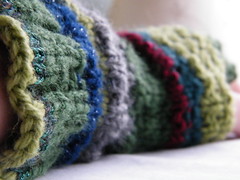
#Plateaknit Wristwarmers by Ingrid Murnane

Well, it has been a month since #plateaknit took place and I'm only now feeling able to wrap it up. I must admit to having had total knitting burnout, not to mention writer's block over the project. Five intensive days of knitting, knitting, knitting for hours took the fun out of it, to be honest. But eventually, as with all things, it worked itself out and here I am again.

If you missed it at the time, or if you would like to follow the entire performance and knit or make something from the tweets, you can visit the hashtag vault for #plateaknit, archived on twapperkeeper.

From 25th-29th January, @platea's Project 6, #plateaknit took place. The idea was to perform #plateaknit by crowdsourcing knitting instructions and make up designs via the Twitter hashtag #plateaknit. There were two types of participants in #plateaknit: instructors and makers. @Platea asked the instructors to use the hashtag #plateaknit when they gave the makers abbreviated knitting instructions in a tweet. These were be picked up by the makers and incorporated into the piece they were knitting, or making in some other way. Although we primarily made use knitting abbreviations, it was important that makers used whatever media they liked to interpret and perform.

That is all very well on paper, but how did it work in practice?

I performed #plateaknit as both an instructor and a maker. The project gave myself and others the freedom to instruct in uncommon ways and without necessarily knowing how others would interpret it or indeed if they would at all. Due to none of us knowing how the finished items would turn out, the conventional order of succession of the pattern, and even the usual abbreviations within the language of a knitting pattern were suspended. Several things stood out from the volley of instructions given across Twitter. As well as the conventional knitting recipes tweeted, there were instructions which pertained to transient events which even now are no longer current and that may in the future defy easy explaination or interpetation. The two main examples were Apple's launching the iPad and the UK's Iraq Inquiry. These gave rise to tweets such as:

#plateaknit INSTRUCTION wrap & turn (a short row) when anyone in your twitter stream mentions #Blair #IraqInquiry
(@brendadada)

and

#plateaknit kfb every time someone tweets about the Apple tablet (@thatwaszen)


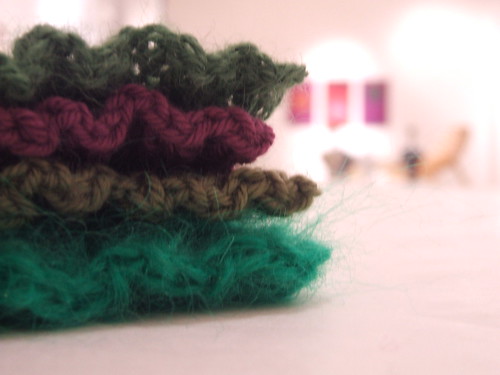
Detail of #plateaknit project by Ingrid Murnane

The temporal nature of the project came out again in the use by @InnBrooklyn of instructions to be interpreted first via morse code and then knitting. Knitting into your hat what you had for lunch on a given day will change whenever you knit this, but unlike our interest in Tony Blair's apparant misdoings, lunch remains a constant. There was also the option of ReTweeting an instruction at will, in order to repeat it:

RT @Bungy32: Weave an 8" bit of yarn into the next 9 stitches. Let leftover tails dangle on RS of piece. RT this instr. to repeat. #plateaknit

I felt that the instructions given by those who were not knitters were particularly interesting. Although some did make use of 'conventional' abbreviations, most gave us rather more out-there tweets including @newcurator's 'knitting interlude' the results of which you can see on his site.

Hello #plateaknit crew! For the next row only: close yr eyes & trust yr inner-knitter (@sortingtrolley)

Plateaknit2 by joaniesanchirico. Used under Creative Commons licence.

...and how did all of this translate when making something from it.
As knitters we are used to following a pattern: this was DIFFERENT. Oh yes. In being a maker, I dipped in and out of the feed, as and when I was on twitter. I knitted for about 5-6 hours each of the five days and ended up making two hats, some wrist-warmers and starting a full-instruction scarf too. Initially I had chosen two greens as my base colours and knitted predominently with them. Changing colours when instructed, adding and subtracting stitches and yarns, and interpreting others' instructions as I pleased. I did wonder though, whether my instructions were being influenced by what I was making, rather than the other way around. For instance, I fancied a bit of zing in my hat, so I tweeted an instruction to 'make the next five rows sparkle'. I'm not sure whether that matters or not either.

There were a lot of scarves knitted from the instructions and a long, flat item does lend itself to the instructions rather well: much like a visual print-out.

#plateaknit scarf by itsokadascat. Used under Creative Commons licence.

@_randomthoughts made a great interpretation of the tweets in her drawing, below.

'Hat' by wecome_to_my_own_little_piece_of_heaven. Used under Creative Commons licence.


I think that Christi Nielsen summed up the project best of all when she described her #plateaknitting as 'a roadmap, of sorts, of your tweets the last few days'.


I'd like to extend my thanks to all participants in #plateaknit, both instructors and makers, and say a big thanks you to An Xiao for letting me be the first resident for @Platea Project Space.

Sunday, January 24, 2010

#Plateaknit Performers, by Ingrid Murnane

Magic Loop by InnyNaney on Flickr


In order to get the best out of an @platea performance, each performer needs to follow the others. This is especially important in #plateaknit for getting your instructions as a maker and also for seeing what the makers are doing with the instructions.

Below are the performers so far, and it isn't too late to sign up now: we will add you into the list and make announcements of new performers via the @platea Twitter feed as we go along (so be sure to follow us too!).

The Performers

Brooklynne: Instructor: @grrlshapedyarns

CassieLouise: Instructor: @CassieLouise

Ingrid Murnane: Instructor and Maker: @InnyM

Jonny: Instructor and Maker: @bungy32

Yael David: Maker: @yberryfurrealz

Brenda: Maker and possibly Instructor: @brendadada

Dawn: Maker: @dlad2002

Joanie San Chirico: Maker: @joanie_s_c

Betsy Mitchell Henning: Maker: @FunkyFatGirl

D: Instructor: @sortingtrolley

Jim: Maker: @RaggedJ

Neene: Maker: @_randomthoughts

Talia: Instructor: @innbrooklyn

Amy: Instructor: @plainsight

An Xiao: Instructor: @thatwaszen

Lisa Risager: Maker: @risager

Glenda Greenhouse: Instructor: @G_Greenhouse

Elseline: Maker: @ElselineT

NewCurator: Instructor: @NewCurator

Aaron Chen: Instructor: @clockity

Christi Nielsen: Instructor and Maker: @christinielsen

Runfox: Instructor: @Runefox

Amy Barnes: Maker: @dr_amyjaneb

Thursday, January 14, 2010

PlateaKnit -- Thinking about Knitworks


About five years ago, as the result of an inspired if chancy Christmas gift from my partner, I learned how to knit.  After three days of cussing at yarn and needles, I finally taught myself the basics.  From there, my learning curve was steep.  More than just an avocational distraction, I found knitting (and later crochet) stimulates my thinking about a variety of academic projects as well as my participation in on-line communities.  Maybe it's the time involved in meditative looping and counting and maintaining a consistent tension that frees the mind to wander and make associations; maybe there's something deeply metaphysical about careful and planned manipulation of strand into fabric into garment.


So, I was very excited when a member of @Platea proposed a project involving knitting from a crowdsourced pattern generated on Twitter.  Ingrid Murnane's project not only intrigues me as a knitter, but also as an artist and academic who spends considerable time thinking about art and communities.  Several themes emerge for me as I contemplate the Plateaknit project and the link between knitting and on-line networks.  This is by no means an exhaustive list.  In fact, as with all performance inquiry, I look forward to our adding to and modifying this list as we engage in the project.

1) Networks/Knitworks -- As a textile craft, knitting (like crochet and weaving) is about creating a material network of fibers in a lattice.  The kind of free-form knitting this project prefers (in crochet, sometimes called "scrumbling") is even more like the organic, chaotic networks of folks linked by the internet, (in Network Theory,  sometimes called mesh networks).  And if the net is still predominantly text-based, it is worth remembering that "text" and "textile" are etymologically linked.  (Hey, we don't call it a "web" for nothing!)  It is also worth remembering that the computers we use to have this discussion owe their data processing origins, in part, to the textile industry of weaving.

2) DiY Aesthetics -- Performance Studies folks have been talking a lot about this idea lately -- the idea of media and art production done outside traditional institutions and training for such, and often not for any kind of financial gain.  The concept borrows a bit from the logic of the potlach and economies of gift-giving.  In explaining the DiY aesthetic, my partner (a fellow Performance Studies scholar) and I often reference our knitting and crochet practices:  we make scarves and hats for the pleasure of making them and then enjoy giving them away.  The joy is a product made by the hand of someone you know and not simply bought or manufactured in institutionalized systems of exchange.  In an increasingly globalized culture of consumerism, knitting (among other arts/crafts) at the very least expresses a desire for something other than the mass produced.  (Although, admittedly, there is plenty about knitting that supports commodity fetishism -- as a proliferation of specialty stores, expensive yarns, and my colossal fiber cache demonstrate.)


3) Social Knitworking -- If Ravelry.com is any indication (and it is not alone in this), the relatively recent revitalization of knitting has benefited significantly from social networking.  Blogs and social networking sites abound for sharing knitting resources and projects.  Several folks have even taken advantage of webcams to produce (really helpful!) tutorial videos.  This is the sort of hobby/art/craft that seems to thrive in and form non-geographically-bound, interest-based communities.

4) Specialized Codes -- I think the specialized abbreviations of knitting instructions (easily one of the most frustrating aspects of learning to knit) are a lot like the specialized abbreviations used in text messages and character-constrained micro-blogging.  Both endure a certain amount of push-back from folks who find such abbreviation alienating and unnecessary.  And yet, in both cases, there are similar motivations for the abbreviations.  For texting and micro-blogging, character limits and numeric keypads necessitated the organic development of abbreviations.  For knitting, abbreviations first showed up in newspapers that limited the column inches available for craft instructions.  In both cases, these abbreviations have found their way into discourse less constrained by need for such efficiency.

5) But is it Art? -- Finally, at a time when digital art and social networking performance events still (occasionally) suffer derisive dismissal by established "fine" arts practitioners, knitting offers a practice similarly caught in categorical debates between "craft" and "art."  Certainly, there are textile artists who use knitting to make soft sculptures, and for some this leads to a tension between knitting for practical use and knitting for an art object.  Nonetheless, it is rare that knitting finds its way into a regular part of the the Fine Arts curriculum.  A potentially interesting alchemy occurs when we mix the two forms -- one relatively new, one relatively old, and both viewed with some skepticism by the Keepers of the Canon.

With these thoughts looping back on each other in my mind, I find myself eager for the needles and tweets that will weave this next @Platea project.  


(Posted by Jonny Gray, a.k.a. Bungy32.  All illustrations in this post created by me.)

Wednesday, January 13, 2010

Project VI: PlateaKnit. 25th-29th January, by Ingrid Murnane

I’m a knitter. Any of you who follow me on Twitter will know this: sometimes it might seem that it is all I go on about. There are a few of us who are on the @platea Steering Committee who also knit, so really it was only a matter of time before there was a knit-related performance.

I’ve been thinking for a while about combining social networking and knitting more than I do already, by crowd sourcing tweets to make a knitting pattern. I thought that I would decide on a basic pattern to follow, perhaps for a hat or scarf, but would receive the instructions for any other details from my twitter followers. It’s something which I’ve sort of done before, with the aid of a few friends, but not on such a scale.

I mentioned it to An Xiao and the rest of the @platea Steering Committee and although not all knitters they thought it could be an exciting idea to try out over Twitter. So here goes!

Tension Squares by InnyNaney. Used under Creative Commons License.

The Project Details

The performance will take place on 25th – 29th January on Twitter only.

You can take part in two ways this time: as an instructor and as a maker. We will ask the instructors to use the hashtag #plateaknit when they give the makers abbreviated knitting instructions in a tweet. These will be picked up by the makers and incorporated into the piece they are knitting. Although we will be making use of knitting abbreviations, makers can use whatever media they like to interpret and perform: perhaps your drawing or photography could be influenced by the knitting pattern instructions?

If you do decide to knit, you can either cast on a number of stitches to work from as a base and follow the instructions to make a freeform piece of work, or use a garment as the basis for your performance. Simple things will work better for this such as scarves, shawls and basic hats. It doesn’t matter what kind of yarn or needles you use either. As with all making, there will be a certain amount of personal interpretation of any instructions to fit what you are making.

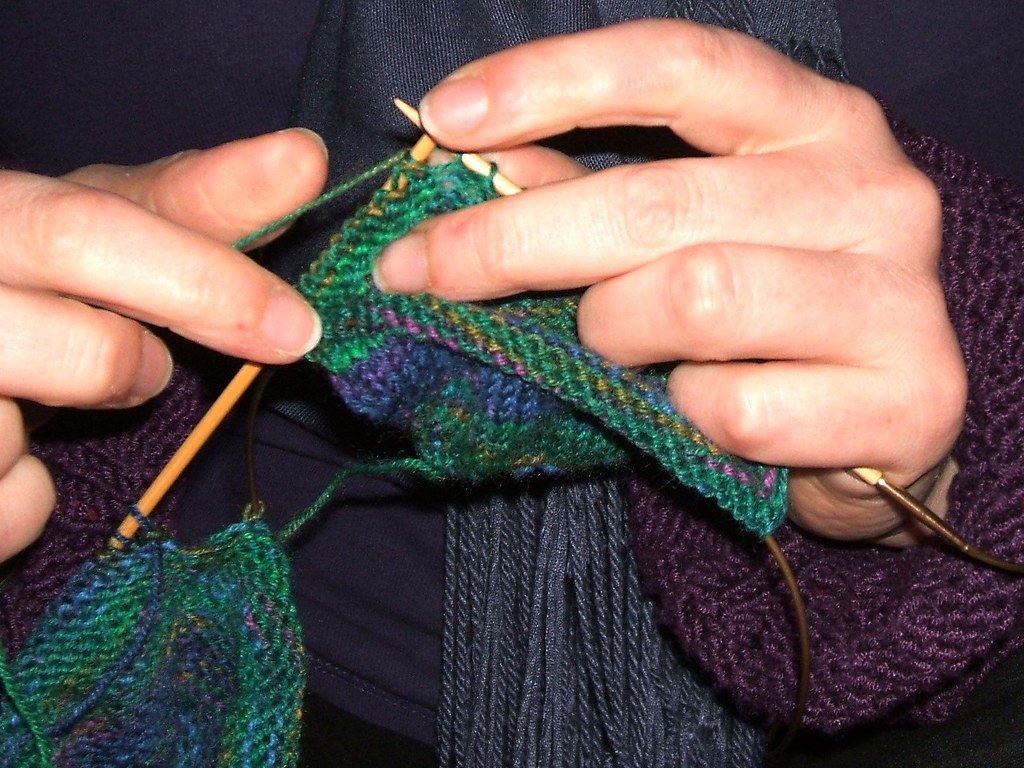
Knitting Round the Table by InnyNaney. Used under Creative Commons License.

It will of course be possible to search the #plateaknit hashtag in order to see the whole pattern as it grows, and to follow the instructions in their entirety, but it will also work if you dip in and out of the feed. We have @platea performers on many continents and in opposite time zones, so we won’t all receive the tweets at a time appropriate to us. You may choose to follow just one or two people’s tweeted instructions, to only participate when you see an instruction telling you to do a certain thing (e.g., make an eyelet) or just go completely freeform and dip in and out of the main instruction pattern whenever you are online. It is entirely up to you: that’s the fun of it. We will all come up with completely different interpretations of the pattern instructions, which makes such a diversion from the traditional process of following a knitting pattern.


Knitting Abbreviations, you say?

For those of you who are not familiar with knitting abbreviations, I will be posting a good basic selection of instructions and ideas with notes on how to use them on the blog shortly for your use. Here are a couple of examples of what might be used, though:

Tweet 01: sl1, k1 *m1, p2, k2tog, p1* (repeat from * three times) k to end #plateaknit

Tweet 02: Do two rows in the colour you are currently working with then change to something (more) green. #plateaknit

Tweet 03: Change one of your needles up three sizes. #plateaknit

Tweet 04: Add five stitches to your next row in any way of your choosing #plateaknit

Tweet 05: Bind (cast) off and start a new piece. #plateaknit

Tweet 06: Do the next five rows in a k2, p2 rib. #plateaknit

Tweet 07: Make it shine! #plateaknit

Don’t be startled with all the lingo if you’re not a knitter: some makers might like to interpret the instructions differently, instead doing something (for example knitting an eyelet, changing needle sizes or switching to blue paint) whenever a particular word such as ‘and’ or ‘row’ is mentioned in a tweet or when somebody tweets about food. This is kind of like Lee Meredith’s Game Knitting concept, if you’re familiar with it.

Basically, makers will interpret instructions to the best of their abilities, including (if they choose) interpreting any part of an instruction tweet as additional guides. It really is up to you how off the wall you want to make this performance. Whatever you do with it, however simple or complicated you want to make it, just have fun!

If you are a knitter and are on Ravelry, then we will be documenting it there on ourhttp://www.ravelry.com/groups/platea, and also on the @platea Facebook fan page. You can add your works in progress (WIPs) to the @platea Flickr pool throughout the week and we will feature some on the blog too. Of course, be sure to follow us on Twitter.

We are also planning a series of blog posts in the two weeks after the performance featuring the final articles that you’ve made. I would love to see what you’ve made and additionally read some commentary about how you have interpreted the instructions. It would be great to hear from knitters and non-knitters; instructors and makers, alike. I am going to knit up something with the full instructions which may take a while longer than the performance lasts, as well as knitting something smaller in real-time, and this final piece will be shown here on the @platea blog and will also be available as a pattern on the online knitting magazine, knitonthenet in the near future.

Hope that you are able to join us.

Please do sign up below in the comments as either an instructor, a maker or both.

Monday, November 16, 2009

Following Piece 2.0 : Are you following me? by Stella Untalan

Everything is about following.
Are you following me?

I was intrigued by the { following 2.0 } project at many levels. Not the least of which was my twitter handle : stellth. Stellth is one side of me. Stellth is a silent observer, an investigator, a documenter. Stellth is unseen.

Being an observer is essential to stimulating the imagination. Observation and imagination were key to my process in this piece.

I decided that I would use small identifying details in my tweets to hold the thread together for my followers. In this way, if their attention lasped or a tweet or two got past them they could fill in the blanks and recover. It made entering the piece at any point viable. A follower didn’t need the whole story to become engaged and then follow.

Living in a walkable city made picking subjects and logistics easy. I selected someone by a physical attribute: hair color, jacket, bag. I was never really close enough to hear any of the conversations of the individuals that I followed. This is where I mixed the factual and imaginary.

IMG_3273
© 2009 Stella Untalan

The first person I decided to follow, a blonde woman I often see on my way to the gallery, avoided me the first day. I had to decide if I would skip her and follow someone else as my first subject. I decided against it. I imagined that anyone who knew I was doing the piece would wonder what happened. That would be all for the good. Intrigue from the start.

Twitter / stellth: The woman with the blond h ...

My first tweet:

The woman with the blond hair put on her raincoat, took her umbrella and headed up 18th street. #fp20

and then :

How had she avoided me all day yesterday? #fp20


Early on I decided that I would wait if the blonde woman disappeared from view. I would wait as long as it took until she reappeared. On the very first follow I waited from 10:40 AM until 1:56 PM. While I waited, I thought out loud sending a few tweets to keep connected to the story. Letting my followers know I was still making the piece.

tweets :
I'm waiting. For her. #fp20

I have no idea how long it will be. I imagine it must be a meeting, an appointment. 45 minutes? an hour? #fb20


Methodology : observe and let the story unfold, improvise.


By the time the blonde woman emerged I had a couple replies from followers on twitter and Facebook. They asked me, who is the blonde woman? why are you following her? One person asked me if I was stalking... I gave them the link to the project post. They were intrigued and excited to continue following the piece.

I had lunch with a friend who asked me outright, who is the woman? Do I know her? I replied : Follow.

I had decided not to map my actions or use photos in my tweets. I wanted the narrative and my followers to use their observations and imagination to extend the story. They sent me tweets asking, what store, what cafe?

tweet :
The bag is TINY. Thinking about what could be inside. Can't be a pastry can it? #fp20

Dragonfly Cakes - Petits Fours - Petit Four - Home
http://www.dragonflycakes.com/

When I tweeted about the TINY bag a whole flurry of questions came at me. Guesses. I would reply. More guesses. Links to reference materials about different kinds of candy and French pastry. It was an amazing interaction. Surprisingly, the most investigative responses happened on Facebook (I import my feed). Maybe it was because people knew me and felt comfortable.

tweets :
I'm thinking of a name for the woman I am following. Should I name her so that this stream sounds less impersonal? Not her real name. #fp20

The response was a resounding NO. I was pleased. I didn’t really want to give the blonde woman a false name, and my followers agreed.

The last interchanges with my followers were around the sister that visits the blonde woman. I assume it is her sister; they look so much alike. My followers suggest that whatever was in the TINY bag was to share with the sister. A special treat they enjoyed together when they were young and that they still share today.

tweets :
She's coming back out. A car has pulled up. A rental car. I can see the little enterprise e logo. She's greeting the driver. #fp20

The blonde woman is opening a gate for the car to enter. The woman in the car is parking. They are hugging. #fp20

My unexpected joy in making this piece came from the interaction with my followers who were open to writing the story with me. Imagining and embellishing as the story unfolded.

The idea of a cover of the Acconci piece on twitter and compressing the timeline fits our current culture perfectly. All of the performances can be viewed on Twitter using the search term #fp20.

Are you following me?

Monday, November 9, 2009

Those Who Follow

While developing my concept for Following Piece 2.0, I realized that it would be difficult to follow subjects on foot as Acconci did in the original piece, since I live in the suburbs, and not NYC. I shared my intention to participate in the project by posting the @Platea blog post which announced the performance on FaceBook. There was an immediate response from one of my “friends” stating that the piece would amount to stalking, saying “ ... if someone followed ME and tweeted about what I was doing, I'd be freaked out and angry and would probably call the police.” Yet this same person posts to hundreds of people about her daily activities, blurring the line that separates public from private as it exists in the social phenomenon of cyberspace vs. real space.

Because of these initial concerns, and to avoid any misconceptions, I decided to come up with a performance that was different yet in keeping with the Acconci piece. Coincidently, I had been working on the Gagnon family genealogy and had done some fact-finding on the origin of the name.

First, a definition - stalking (the act of following prey stealthily)

Research shows that my family name could have originated from either A) The nickname for an aggressive, belligerent young man, or cruel person from the Old French gagnon “mastiff” or “guard dog” or B) Derived from the Old French “gagneau”, which means “to till or cultivate”. Since my ancestors were farmers, I personally think that option B) is more likely, but if the name indeed came from A), an “aggressive, cruel person” or “guard dog” would probably “follow prey stealthily”. That was it! I was excited that I had developed a concept that was innovative and yet was still faithful to the original.

My plan was to post about my ancestors from as far back in history as possible, chronologically to the present day. Without the internet to do much of the research, my cover of the piece would have been impossible. I realized that instead of just names following one another, these names had existed and had been real people. The story started in the year 1532 with Barnabe Gagnon and finished with me. I previously had a compiled genealogy and even have been to visit the original family home, La Gagnonnierre, in the Perche region of Normandy in France, so I had my tools at hand to start.

@joanie_s_c START: The year 1532. Those who follow. Barnabe Gagnon is born in Tourourvre, Perche, France.

Image: La Gagnonierre, Tourourvre, Perche, Normandy, France

What I didn’t realize was that I would get so affected by these former “just-names” on paper. I became obsessed about these “now-people”, wondered what they did for a living, where they lived, how they survived the crossing to New France, and what they did when they got there.

In my research, I learned that the houses that the three Gagnon brothers built when they arrived from France in Chateau Richer, Quebec in 1635 are also beautifully preserved, as I had witnessed with the farm in Normandy. All the houses are still lived in and commemorated with plaques documenting the family history. The homes which I had previously imagined as shacks, are still impressive. I found that rather than continue as farmers, the Gagnon brothers became shopkeepers shortly after they arrived in Canada. I found ancient land deeds and marriage and death certificates.

@joanie_s_c The year 1635. Those who follow. Pierre Gagnon and his brothers leave Normandy for the New France, now Quebec, Canada


Image: Pierre Gagnon's home in Chateau Richer, Quebec, Canada. Built in 1652.

When they moved to the US, I also learned that my grandparents lived in Nashua, NH before moving to Lawrence, MA, where they stayed until they died.

@joanie_s_c The year 1911. Those who follow. Theodule and Aurore Gagnon move to Nashua, NH from Quebec, Canada

Image: The Gagnon family, 1911. Theodule and Aurore with daughter Reine at left.

@joanie_s_c END: Those who follow. Joan-Marie Estelle Gagnon, Lawrence, MA. Portrait age 5


Utilizing the power of social media, specifically Twitter, my tale unfolded. At one point Quebec News picked up on my posts and started re-tweeting my storytelling. Many of my own followers told me that they were finding my story very interesting and were looking forward to the next “installment”. As a result, my performance evolved into a many layered re-enactment of Following Piece:

1. One generation following the other (My original plan)
2. My new interest from following and learning more about my ancestors (Resulting in unexpected discoveries)
3. Other people began following my story (Social media’s affect on my story telling)
4. Quebec News picking up on my performance and re-tweeting to their followers (My family story had suddenly gone very public)
5. In turn, those who follow that news agency now followed my story (New anonymous followers)

Incidentally, I also found in my research that there are hundreds of Gagnons who are artists. Some I knew about, for instance, the well-known Canadian artist Clarence Gagnon, but there are also many contemporary artists. I’m not sure if this is coincidence or a trait that has been passed down through hundreds of years. I’m fascinated though, and definitely will be investigating this possible common factor.

In the end, the stalking fears turned out to be unsubstantiated. While Acconci’s piece evolved without many people noticing, the result of using social media to create “Those Who Follow” caused hundreds of people - quite a substantial audience, to follow the performance of my Following Piece 2.0 which merged the past with the present. All of the performances can be viewed on Twitter using the search term #fp20.

Thursday, October 22, 2009

Project V: Following Piece 2.0 - Oct 26 - 30

Follow The Leader Up Butternut Creek
Image courtesy KaCey97007

Context
A few months ago, shortly after Michael Jackson had died, I was clicking through YouTube to listen to some of his old classics. I stumbled upon this great cover by KT Tunstall of the Jackson 5 favorite, "I Want You Back":


It got me thinking about art, fine art, conceptual art. In the music scene, cover songs are super common, both among emerging musicians who want to connect with the crowd and established musicians. To me, a cover song is not a tribute to another artist, or a derivative work, or imitation, or a remix. A cover song is just darn fun, and it's good music.

Artist Vito Acconci. Image courtesy Wikimedia Commons.

Following Piece 1.0
Forty years ago, in October 1969, artist Vito Acconci performed Following Piece. A study in the public spaces we occupy and assumptions around privacy, Acconci followed random people in Manhattan during the month and reported on their activities until they entered a private area such as an apartment or car. Here's what Media Art Net had to say about it:
Following Piece is one of Acconci's early works. The underlying idea was to select a person from the passers-by who were by chance walking by and to follow the person until he or she disappeared into a private place where Acconci could not enter. The act of following could last a few minutes, if the person then got into a car, or four or five hours, if the person went to a cinema or restaurant. Acconci carried out this performance everyday for a month. And he typed up an account of each pursuit, sending it each time to a different member of the art community.
A pioneer in conceptual art, Acconci's Following Piece marked a shift in his own artistic interests, as he began to look at how we occupy public space. His results, which I found on Design Boom, struck me as not unlike a series of Twitter or FourSquare updates, decades before these technologies made the public broadcast of somewhat-private actions in public space normal.

It got me thinking. I always loved his piece, and I wondered how he might perform it in this age of social media and mobile phones. So why not do a cover?

Grand Street: Texting
Image courtesy moriza.

Following Piece 2.0
And so, with that in mind, I thought it might be fun to do a cover of Following Piece, but to look at it specifically in the contemporary context of Twitter, a world where public/private boundaries are shifting and eroding, as once-private activities are broadcast into online public space. In the world of Twitter, the idea of following has taken on a new meaning: once an uncomfortable thought, it's now regularly seen as a good thing to have one's private actions followed by many strangers.

In short, from October 26 to October 30, we're asking anyone interested to join a public performance of Following Piece in the social media sphere. Following Piece 2.0. We would use Twitter, and we'd apply the hashtag #fp20 to make it super clear that our tweets are part of the performance.

What would Following Piece 2.0 look like? Here are some thoughts:
  • Tweeting about a person you're following on Twitter. Let's say you're following @mrskutcher and she says she's going to a party. In Acconci's original piece, he never identified the subject per se, so you might tweet: "Lady with glasses and short hair is going to a release party #fp20"
  • Tweeting about a person you're following in real life. I live in New York, and I accidentally follow people all the time if we happen to be going in the same direction. What if you followed someone for a little bit and live tweeted what they're doing?
  • Tweeting for a person you're following in real life. When sitting on the bus, I often like to imagine what other people are thinking or what they'd be tweeting in that moment.
  • Integrating geolocation social media services like Foursquare and Brightkite.
  • Use your imagination!
If you're interested, drop your name and Twitter handle below, or just start tweeting on October 26. Just be sure to use the hashtag #fp20 so we know what's what!

You're never too old for a good game of follow the leader

Very Important Note
Before we begin, we want to make it super duper ultra clear that we are not encouraging stalking, cyberstalking, harassment or anything else of that nature. If you follow someone online, you may wish to ask them beforehand if they would be okay with your performance. And if you're following someone offline, keep in mind that they may not be comfortable with what you are doing. In all cases, be sure to respect local laws and, importantly, respect people's right to privacy.

Saturday, October 3, 2009

'The Dive', A Poem in Seven Tweets, by Peter Glen (@stonefly)

We loved @stonefly's Dive performance and just had to share it here. Be sure to read it from bottom up.

Wednesday, September 16, 2009

Project IV: The Dive ... A Rainbow of Paper Airplanes - by Alex von Vaupel

this fickle season
of rain and sunshine
i try my luck
and go in search
the rainbow’s end


Skydiving
When @platea announced Project IV: The Dive, I loved the idea immediately. I had a vision of a rainbow of coloured paper airplanes skydiving into a crowded street. The airplanes would have poems printed on them. Would anybody notice? Would the poems just get trampled, or would people catch an airplane, stop to take a closer look?

The Dive was announced at short notice, so I didn't have much time to prepare. My original idea had been to let the airplanes skydive somewhere in Amsterdam, but as it turned out, I was in Canterbury, UK, on the specified dates. I had fun playing with the idea, trying different things to make it work. Practicing how to fold a paper airplane that will actually fly, selecting poems, walking around town to spot the best location. I came up with an airplane design that had the poem printed on the wings, and links to the Platea blog and my own printed on the inside.

Paper Airplanes - Photo by Julia Freeman

It's hard to find a crowd in Canterbury, on a september week day. The tourists have gone, and the students haven't returned yet. The busiest place I could find was a spot in the highstreet near some popular sandwich bars, where many people buy their lunch.

grey morning
drawing
my own rainbow


So, on wednesday, Sept 9th, I went to the city centre with my bag full of paper airplanes, to launch them into the street. I teamed up with photographer Julia Freeman to take pictures of the airplanes flying around. All the pictures posted here were taken by her.

I had imagined to make a nice rainbow arch with the airplanes, but of course the vision I had did not factor in practicalities like the direction of the wind ...
The airplanes went Everywhere! Some people caught them and read the poem, some people just walked by, others threw the airplanes back at me. A few were annoyed, this was not a crowd of tourists, they were busy people trying to get back to work. I know I had fun throwing the airplanes at them anyway!

Paper Airplane - Photo by Julia Freeman

It was just like the leaves falling off a tree, most people never look up to notice, the leaves get trampled on. Occasionally someone like me will come along and watch, maybe pick up a leaf and take it home.

A dive back into childhood...
Those people who stopped to talk to me all commented how the airplanes reminded them of being a child:'oh i loved to do that when I was a kid' ... 'my daughter would love this'... 'isn't it fun being twelve!'

I think they were right, this was a dive into childhood, for me and for the public. The airplanes invited people to remember that childish curiosity that makes us notice things. Especially those things that busy grownups ignore. A child will stop to marvel at the leaves falling from a tree, collect the leaves, play with them.

Paper Airplane - Photo by Julia Freeman

It's that attitude to the world that is needed to write haiku and tanka poetry, to notice what is happening, take a moment to reflect. The photos Julia managed to get of the flying airplanes have that 'haiku moment' feel to them. Stop, look around you!

they see only street
commuters passing by
the tree
throws conkers
at their heads


Practicality
With hindsight the project could have done with more preparation, and a better location. Perhaps with a more captive audience, like people sitting in a park or a square in a big city, on a summer day. More airplanes and a good spot to throw them down from would help create an actual rainbow.

On the other hand, you have to be careful, if the crowd is too big, it becomes difficult to aim... you don't want the point of an airplane hitting someone. Also beware of the authorities, I am not entirely sure if I would have needed a license, had I done this on a bigger scale. I made sure to pick up after myself, in order not to get nicked for littering.

Paper Airplane - Photo by Julia Freeman

The airplanes went down quickly and many ended up trampled on the street. This skydive was as brief in real life as the pictures and poems dived through my twitterstream.

The practical aspects may need a little work, but clearly the concept worked: people loved the idea, and it had the desired effect of making people stop and wonder, remember what it was like to be a child, before moving on.

I would like to thank the @platea crew for this wonderful, playful opportunity. Please comment and let me know what you think!

Monday, September 7, 2009

Ready for The Dive? Here's the list of performers (it's not too late to sign up!)

Alrighty, folks, are you ready for The Dive? Here's the final list of performers for Project IV, but REMEMBER that you can simply add your name to the comments, and we'll pop it on this list. I know I saw a few other folks were talking about The Dive on Twitter, but they didn't formally sign up, so please just feel free to add your name to the comments, and I'll place it on the blog post right away. We may extend the performance to Friday, in any case.

And, just start diving!


PG Stonefly
Twitter

Jorge Alvarez
Twitter, Facebook

Alex Von Vaupel
Twitter, Facebook, Blog

Cynthia Lewis
Twitter, Facebook

Aaron Chen
Twitter, Facebook, FriendFeed, Flickr

Trish Mayo
Facebook, Twitter, Flickr

Amy Finkbeiner
Twitter

Shelby Cunningham
Twitter, Facebook, Flickr

Lisa Hoang
Twitter

Christi Nielsen
Facebook, Twitter, Friendfeed, 12seconds

Jonny Gray
Twitter, Flickr, Facebook, Blogger

Carse Ramos
Facebook, Twitter, Flickr

Joanie San Chirico
Twitter, Facebook, Flickr, Blogger

Jennifer Ng
Twitter, Facebook, Flickr

D.
Tumblr, Flickr, Twitter

Yael David
Facebook, Twitter

Ingrid Murnane
Facebook, Twitter, FriendFeed

Sheila Cunningham
Twitter, Facebook

An Xiao
FriendFeed and Facebook

Monday, August 31, 2009

Project IV: The Dive - September 8-10

Reene's Swan Dive
Photo via mcescobar1 on Flickr

Context
I've had this idea brewing for a good while now, immediately after I saw that Facebook would be moving into a real-time update model. I knew that I wanted to take a look at this move toward real-time and immediacy online, but had to focus on other @Platea projects for the moment.

It's been almost six months since Facebook went real time in March, and we've seen an even greater trend toward real-time. Facebook acquired popular social media aggregator FriendFeed, which offers push updates in real-time. And we've seen Twitter suffer a number of server hiccups, leading to much angst all around when updates were delayed.

In short, immediacy is quickly becoming the norm in social media.

Lighthouse Diving - Dovercourt Essex
photo via Jibba Jabba on Flickr

Project IV: The Dive
As the summer comes to an end in the northern hemisphere and the fall art season heats up, the steering committee and I thought it might be fun to have one last hurrah with a public dive through social media. The performance will be September 8 to 10, and we're asking our performers to use the real-time news feed as a visual performance space for diving.

Just think about it: you go online, you check your Facebook and FriendFeed feeds, and as the day goes on, each status update and picture post slowly makes its way down. If it's a busy day and you have a lot of friends, these updates slide down quickly. If it's a slow day, they get there eventually. Imagine a picture of yourself diving through this space, gradually making your way down your friends' news feeds.

Sounds kinda fun, huh?

Emerald Dog Dive.
Photo via Jeffrey Beall on Flickr

How to Participate
Participation is simple. For three days, from September 8 to 10, we're going to take a collective plunge. Here's how:

1. Write your name and links to your social media sites in the comments space below. The most effective sites for The Dive will be ones that show a picture as they update. Facebook's news feed is the most obvious, as is FriendFeed. Flickr is also a good option, and I'm sure there are a few more. Even your own personal blog could work--it would just be a very slow dive if you don't update very often!

2. Follow @Platea on Twitter and/or join the @Platea Facebook group. We'll be posting thoughts and ideas for inspiration in preparation for the week. Feel free to share your own, and we'll retweet or repost them.

3. Set up a self-timer or grab a friend and take pictures of yourself "diving". No, you don't have to be wearing a bathing suit. It doesn't even have to be you. All that matters is that you find some way to visually represent a dive. The fun part will be watching this image slowly make its way down your and your friends' news feeds, as if it's, well, diving.

4. It may be helpful to explain what the heck you're doing. If you're using Facebook, you can set up an album called "The Dive: @Platea Project IV" with a description of the images. Here's one suggestion:
From September 8 through 10, I'm participating in "The Dive", a public performance art project organized by the @Platea collective. It's kind of strange but also kind of fun. Learn more about it at http://plateastweets.blogspot.com/2009/08/project-iv-dive-september-8-10.html.
5. By Monday, September 7, we'll post a running list of who's participating, with links to their sites.

6. On September 8, start diving! Dive once a day, dive once an hour. Synchronize dives with friends and do some cool tricks. Dive as much or as little as you want. Dive at different times of day. Have fun and enjoy the end of the summer.

Simon Sky Diving
Photo via GoGap on Flickr

Questions? Ideas? Thoughts? Send an @reply to @Platea on Twitter or leave a comment here.