Sunday, January 24, 2010

#Plateaknit Performers, by Ingrid Murnane

Magic Loop by InnyNaney on Flickr


In order to get the best out of an @platea performance, each performer needs to follow the others. This is especially important in #plateaknit for getting your instructions as a maker and also for seeing what the makers are doing with the instructions.

Below are the performers so far, and it isn't too late to sign up now: we will add you into the list and make announcements of new performers via the @platea Twitter feed as we go along (so be sure to follow us too!).

The Performers

Brooklynne: Instructor: @grrlshapedyarns

CassieLouise: Instructor: @CassieLouise

Ingrid Murnane: Instructor and Maker: @InnyM

Jonny: Instructor and Maker: @bungy32

Yael David: Maker: @yberryfurrealz

Brenda: Maker and possibly Instructor: @brendadada

Dawn: Maker: @dlad2002

Joanie San Chirico: Maker: @joanie_s_c

Betsy Mitchell Henning: Maker: @FunkyFatGirl

D: Instructor: @sortingtrolley

Jim: Maker: @RaggedJ

Neene: Maker: @_randomthoughts

Talia: Instructor: @innbrooklyn

Amy: Instructor: @plainsight

An Xiao: Instructor: @thatwaszen

Lisa Risager: Maker: @risager

Glenda Greenhouse: Instructor: @G_Greenhouse

Elseline: Maker: @ElselineT

NewCurator: Instructor: @NewCurator

Aaron Chen: Instructor: @clockity

Christi Nielsen: Instructor and Maker: @christinielsen

Runfox: Instructor: @Runefox

Amy Barnes: Maker: @dr_amyjaneb

Wednesday, January 20, 2010

Ideas for #plateaknit Instructions and How to Use Them, by Ingrid Murnane

In a follow up to my last post, here are some basic knitting abbreviations and an explaination of how to use them. There are also some other instructor/maker ideas to help you in #plateaknit.

Basics

K = knit

P = purl

These are the two basic stitches. Tell us how many stitches you’d like us to knit or purl like this: k15 or p4.

You can also make a set of instructions as follows: k2, p6, k2, p6, k to end of row.

You can specify the number of rows that we need to knit like this for as well, by adding (for three rows) or suchlike.

If you’d like something repeated, do it following a formula something like this: (k2, p3) 5 times

You can do more than just get us to make patterns with the knit and purl stitches. You can ask us to increase or decrease the amount of stitches in a number of ways, make eyelet holes, ask us to change colours, turn the knitting round and go the other direction or make a buttonhole.

Increase stitches

m1 = make one by picking up and knitting a stitch between two other stitches

kfb = knit front and back

yo = yarn over

yf = yarn forward

Decrease stitches

k2tog = knit two stitches together

p2tog = purl two stitches together

ssk = slip two stitches knitwise, transfer them back and knit them together

Other things to do

Eyelets: yo k2tog = makes an eyelet

Buttonholes: specify the number of stitches width eg: bh5

Change direction: as it says, turn the knitting and work back the other way (as in short row shaping)

Change colours: to make stripes or coloured patterns

Change needle sizes (to larger or smaller ones)

There are many more things you can do in knitting than just these, but these basics should help both the instructors and makers in the performance.


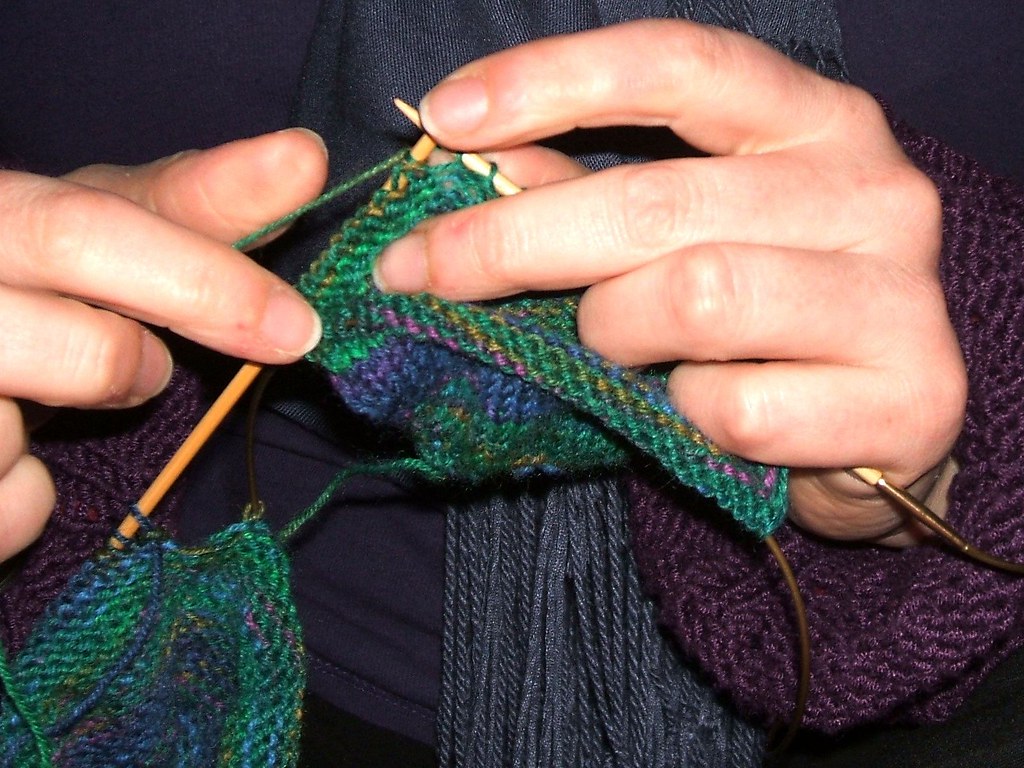
Knitting by InnyNaney on Flickr.


Here are some great examples of ways that you could incorporate knitting instructions into your tweets (with thanks to my fellow Steering Committee member Jonny Gray!)

Tweet01: sl1, k1 *m1, p2, k2tog, p1* (repeat from * three times) k to end #plateaknit

Tweet02: Do two rows in the color you are currently working with then change to something (more) green. #plateaknit

Tweet03: Change one of your needles up three sizes #plateaknit

Tweet04: Add five stitches to your next row in any way of your choosing #plateaknit

Tweet05: Bind (cast) off and start a new piece. #plateaknit

Tweet06: Do the next five rows in a k2, p2 rib. #plateaknit

Tweet07: Over as many rows as you choose, reduce the row to ten stitches wide then expand back to the original number of stitches in the row. #plateaknit

Tweet08: Do a short row of half the number of stitches in your current row. #plateaknit

Tweet09: Weave in a length of packaging twine into part of a row. Leave at least 6 inches of twine dangling on the RS of the piece at both ends of the weave. #plateaknit

Tweet10: Repeat the last instruction five times. #plateaknit

Tweet11: Make it shine! #plateaknit

Of course the makers could also, in the spirit of Lee Meredith’s Game Knitting choose not to use any of the ‘instruction’ tweets as direct instructions and instead do something (for example knit an eyelet or change colours) whenever a particular word such as ‘and’ or ‘row’ is mentioned in a tweet or when somebody talks about food. It really is up to you how off the wall you want to make it! Basically, makers will interpret instructions to the best of their abilites, including (if they choose) interpreting any part of an instruction tweet as additional guides.

Whatever you do with it, however simple or complicated you want to make it, just have fun!


Thursday, January 14, 2010

PlateaKnit -- Thinking about Knitworks


About five years ago, as the result of an inspired if chancy Christmas gift from my partner, I learned how to knit.  After three days of cussing at yarn and needles, I finally taught myself the basics.  From there, my learning curve was steep.  More than just an avocational distraction, I found knitting (and later crochet) stimulates my thinking about a variety of academic projects as well as my participation in on-line communities.  Maybe it's the time involved in meditative looping and counting and maintaining a consistent tension that frees the mind to wander and make associations; maybe there's something deeply metaphysical about careful and planned manipulation of strand into fabric into garment.


So, I was very excited when a member of @Platea proposed a project involving knitting from a crowdsourced pattern generated on Twitter.  Ingrid Murnane's project not only intrigues me as a knitter, but also as an artist and academic who spends considerable time thinking about art and communities.  Several themes emerge for me as I contemplate the Plateaknit project and the link between knitting and on-line networks.  This is by no means an exhaustive list.  In fact, as with all performance inquiry, I look forward to our adding to and modifying this list as we engage in the project.

1) Networks/Knitworks -- As a textile craft, knitting (like crochet and weaving) is about creating a material network of fibers in a lattice.  The kind of free-form knitting this project prefers (in crochet, sometimes called "scrumbling") is even more like the organic, chaotic networks of folks linked by the internet, (in Network Theory,  sometimes called mesh networks).  And if the net is still predominantly text-based, it is worth remembering that "text" and "textile" are etymologically linked.  (Hey, we don't call it a "web" for nothing!)  It is also worth remembering that the computers we use to have this discussion owe their data processing origins, in part, to the textile industry of weaving.

2) DiY Aesthetics -- Performance Studies folks have been talking a lot about this idea lately -- the idea of media and art production done outside traditional institutions and training for such, and often not for any kind of financial gain.  The concept borrows a bit from the logic of the potlach and economies of gift-giving.  In explaining the DiY aesthetic, my partner (a fellow Performance Studies scholar) and I often reference our knitting and crochet practices:  we make scarves and hats for the pleasure of making them and then enjoy giving them away.  The joy is a product made by the hand of someone you know and not simply bought or manufactured in institutionalized systems of exchange.  In an increasingly globalized culture of consumerism, knitting (among other arts/crafts) at the very least expresses a desire for something other than the mass produced.  (Although, admittedly, there is plenty about knitting that supports commodity fetishism -- as a proliferation of specialty stores, expensive yarns, and my colossal fiber cache demonstrate.)


3) Social Knitworking -- If Ravelry.com is any indication (and it is not alone in this), the relatively recent revitalization of knitting has benefited significantly from social networking.  Blogs and social networking sites abound for sharing knitting resources and projects.  Several folks have even taken advantage of webcams to produce (really helpful!) tutorial videos.  This is the sort of hobby/art/craft that seems to thrive in and form non-geographically-bound, interest-based communities.

4) Specialized Codes -- I think the specialized abbreviations of knitting instructions (easily one of the most frustrating aspects of learning to knit) are a lot like the specialized abbreviations used in text messages and character-constrained micro-blogging.  Both endure a certain amount of push-back from folks who find such abbreviation alienating and unnecessary.  And yet, in both cases, there are similar motivations for the abbreviations.  For texting and micro-blogging, character limits and numeric keypads necessitated the organic development of abbreviations.  For knitting, abbreviations first showed up in newspapers that limited the column inches available for craft instructions.  In both cases, these abbreviations have found their way into discourse less constrained by need for such efficiency.

5) But is it Art? -- Finally, at a time when digital art and social networking performance events still (occasionally) suffer derisive dismissal by established "fine" arts practitioners, knitting offers a practice similarly caught in categorical debates between "craft" and "art."  Certainly, there are textile artists who use knitting to make soft sculptures, and for some this leads to a tension between knitting for practical use and knitting for an art object.  Nonetheless, it is rare that knitting finds its way into a regular part of the the Fine Arts curriculum.  A potentially interesting alchemy occurs when we mix the two forms -- one relatively new, one relatively old, and both viewed with some skepticism by the Keepers of the Canon.

With these thoughts looping back on each other in my mind, I find myself eager for the needles and tweets that will weave this next @Platea project.  


(Posted by Jonny Gray, a.k.a. Bungy32.  All illustrations in this post created by me.)
Wednesday, January 13, 2010

Project VI: PlateaKnit. 25th-29th January, by Ingrid Murnane

I’m a knitter. Any of you who follow me on Twitter will know this: sometimes it might seem that it is all I go on about. There are a few of us who are on the @platea Steering Committee who also knit, so really it was only a matter of time before there was a knit-related performance.

I’ve been thinking for a while about combining social networking and knitting more than I do already, by crowd sourcing tweets to make a knitting pattern. I thought that I would decide on a basic pattern to follow, perhaps for a hat or scarf, but would receive the instructions for any other details from my twitter followers. It’s something which I’ve sort of done before, with the aid of a few friends, but not on such a scale.

I mentioned it to An Xiao and the rest of the @platea Steering Committee and although not all knitters they thought it could be an exciting idea to try out over Twitter. So here goes!

Tension Squares by InnyNaney. Used under Creative Commons License.

The Project Details

The performance will take place on 25th – 29th January on Twitter only.

You can take part in two ways this time: as an instructor and as a maker. We will ask the instructors to use the hashtag #plateaknit when they give the makers abbreviated knitting instructions in a tweet. These will be picked up by the makers and incorporated into the piece they are knitting. Although we will be making use of knitting abbreviations, makers can use whatever media they like to interpret and perform: perhaps your drawing or photography could be influenced by the knitting pattern instructions?

If you do decide to knit, you can either cast on a number of stitches to work from as a base and follow the instructions to make a freeform piece of work, or use a garment as the basis for your performance. Simple things will work better for this such as scarves, shawls and basic hats. It doesn’t matter what kind of yarn or needles you use either. As with all making, there will be a certain amount of personal interpretation of any instructions to fit what you are making.

Knitting Round the Table by InnyNaney. Used under Creative Commons License.

It will of course be possible to search the #plateaknit hashtag in order to see the whole pattern as it grows, and to follow the instructions in their entirety, but it will also work if you dip in and out of the feed. We have @platea performers on many continents and in opposite time zones, so we won’t all receive the tweets at a time appropriate to us. You may choose to follow just one or two people’s tweeted instructions, to only participate when you see an instruction telling you to do a certain thing (e.g., make an eyelet) or just go completely freeform and dip in and out of the main instruction pattern whenever you are online. It is entirely up to you: that’s the fun of it. We will all come up with completely different interpretations of the pattern instructions, which makes such a diversion from the traditional process of following a knitting pattern.


Knitting Abbreviations, you say?

For those of you who are not familiar with knitting abbreviations, I will be posting a good basic selection of instructions and ideas with notes on how to use them on the blog shortly for your use. Here are a couple of examples of what might be used, though:

Tweet 01: sl1, k1 *m1, p2, k2tog, p1* (repeat from * three times) k to end #plateaknit

Tweet 02: Do two rows in the colour you are currently working with then change to something (more) green. #plateaknit

Tweet 03: Change one of your needles up three sizes. #plateaknit

Tweet 04: Add five stitches to your next row in any way of your choosing #plateaknit

Tweet 05: Bind (cast) off and start a new piece. #plateaknit

Tweet 06: Do the next five rows in a k2, p2 rib. #plateaknit

Tweet 07: Make it shine! #plateaknit

Don’t be startled with all the lingo if you’re not a knitter: some makers might like to interpret the instructions differently, instead doing something (for example knitting an eyelet, changing needle sizes or switching to blue paint) whenever a particular word such as ‘and’ or ‘row’ is mentioned in a tweet or when somebody tweets about food. This is kind of like Lee Meredith’s Game Knitting concept, if you’re familiar with it.

Basically, makers will interpret instructions to the best of their abilities, including (if they choose) interpreting any part of an instruction tweet as additional guides. It really is up to you how off the wall you want to make this performance. Whatever you do with it, however simple or complicated you want to make it, just have fun!

If you are a knitter and are on Ravelry, then we will be documenting it there on ourhttp://www.ravelry.com/groups/platea, and also on the @platea Facebook fan page. You can add your works in progress (WIPs) to the @platea Flickr pool throughout the week and we will feature some on the blog too. Of course, be sure to follow us on Twitter.

We are also planning a series of blog posts in the two weeks after the performance featuring the final articles that you’ve made. I would love to see what you’ve made and additionally read some commentary about how you have interpreted the instructions. It would be great to hear from knitters and non-knitters; instructors and makers, alike. I am going to knit up something with the full instructions which may take a while longer than the performance lasts, as well as knitting something smaller in real-time, and this final piece will be shown here on the @platea blog and will also be available as a pattern on the online knitting magazine, knitonthenet in the near future.

Hope that you are able to join us.

Please do sign up below in the comments as either an instructor, a maker or both.

Monday, November 16, 2009

Following Piece 2.0 : Are you following me? by Stella Untalan

Everything is about following.
Are you following me?

I was intrigued by the { following 2.0 } project at many levels. Not the least of which was my twitter handle : stellth. Stellth is one side of me. Stellth is a silent observer, an investigator, a documenter. Stellth is unseen.

Being an observer is essential to stimulating the imagination. Observation and imagination were key to my process in this piece.

I decided that I would use small identifying details in my tweets to hold the thread together for my followers. In this way, if their attention lasped or a tweet or two got past them they could fill in the blanks and recover. It made entering the piece at any point viable. A follower didn’t need the whole story to become engaged and then follow.

Living in a walkable city made picking subjects and logistics easy. I selected someone by a physical attribute: hair color, jacket, bag. I was never really close enough to hear any of the conversations of the individuals that I followed. This is where I mixed the factual and imaginary.

IMG_3273
© 2009 Stella Untalan

The first person I decided to follow, a blonde woman I often see on my way to the gallery, avoided me the first day. I had to decide if I would skip her and follow someone else as my first subject. I decided against it. I imagined that anyone who knew I was doing the piece would wonder what happened. That would be all for the good. Intrigue from the start.

Twitter / stellth: The woman with the blond h ...

My first tweet:

The woman with the blond hair put on her raincoat, took her umbrella and headed up 18th street. #fp20

and then :

How had she avoided me all day yesterday? #fp20


Early on I decided that I would wait if the blonde woman disappeared from view. I would wait as long as it took until she reappeared. On the very first follow I waited from 10:40 AM until 1:56 PM. While I waited, I thought out loud sending a few tweets to keep connected to the story. Letting my followers know I was still making the piece.

tweets :
I'm waiting. For her. #fp20

I have no idea how long it will be. I imagine it must be a meeting, an appointment. 45 minutes? an hour? #fb20


Methodology : observe and let the story unfold, improvise.


By the time the blonde woman emerged I had a couple replies from followers on twitter and Facebook. They asked me, who is the blonde woman? why are you following her? One person asked me if I was stalking... I gave them the link to the project post. They were intrigued and excited to continue following the piece.

I had lunch with a friend who asked me outright, who is the woman? Do I know her? I replied : Follow.

I had decided not to map my actions or use photos in my tweets. I wanted the narrative and my followers to use their observations and imagination to extend the story. They sent me tweets asking, what store, what cafe?

tweet :
The bag is TINY. Thinking about what could be inside. Can't be a pastry can it? #fp20

Dragonfly Cakes - Petits Fours - Petit Four - Home
http://www.dragonflycakes.com/

When I tweeted about the TINY bag a whole flurry of questions came at me. Guesses. I would reply. More guesses. Links to reference materials about different kinds of candy and French pastry. It was an amazing interaction. Surprisingly, the most investigative responses happened on Facebook (I import my feed). Maybe it was because people knew me and felt comfortable.

tweets :
I'm thinking of a name for the woman I am following. Should I name her so that this stream sounds less impersonal? Not her real name. #fp20

The response was a resounding NO. I was pleased. I didn’t really want to give the blonde woman a false name, and my followers agreed.

The last interchanges with my followers were around the sister that visits the blonde woman. I assume it is her sister; they look so much alike. My followers suggest that whatever was in the TINY bag was to share with the sister. A special treat they enjoyed together when they were young and that they still share today.

tweets :
She's coming back out. A car has pulled up. A rental car. I can see the little enterprise e logo. She's greeting the driver. #fp20

The blonde woman is opening a gate for the car to enter. The woman in the car is parking. They are hugging. #fp20

My unexpected joy in making this piece came from the interaction with my followers who were open to writing the story with me. Imagining and embellishing as the story unfolded.

The idea of a cover of the Acconci piece on twitter and compressing the timeline fits our current culture perfectly. All of the performances can be viewed on Twitter using the search term #fp20.

Are you following me?

Monday, November 9, 2009

Those Who Follow

While developing my concept for Following Piece 2.0, I realized that it would be difficult to follow subjects on foot as Acconci did in the original piece, since I live in the suburbs, and not NYC. I shared my intention to participate in the project by posting the @Platea blog post which announced the performance on FaceBook. There was an immediate response from one of my “friends” stating that the piece would amount to stalking, saying “ ... if someone followed ME and tweeted about what I was doing, I'd be freaked out and angry and would probably call the police.” Yet this same person posts to hundreds of people about her daily activities, blurring the line that separates public from private as it exists in the social phenomenon of cyberspace vs. real space.

Because of these initial concerns, and to avoid any misconceptions, I decided to come up with a performance that was different yet in keeping with the Acconci piece. Coincidently, I had been working on the Gagnon family genealogy and had done some fact-finding on the origin of the name.

First, a definition - stalking (the act of following prey stealthily)

Research shows that my family name could have originated from either A) The nickname for an aggressive, belligerent young man, or cruel person from the Old French gagnon “mastiff” or “guard dog” or B) Derived from the Old French “gagneau”, which means “to till or cultivate”. Since my ancestors were farmers, I personally think that option B) is more likely, but if the name indeed came from A), an “aggressive, cruel person” or “guard dog” would probably “follow prey stealthily”. That was it! I was excited that I had developed a concept that was innovative and yet was still faithful to the original.

My plan was to post about my ancestors from as far back in history as possible, chronologically to the present day. Without the internet to do much of the research, my cover of the piece would have been impossible. I realized that instead of just names following one another, these names had existed and had been real people. The story started in the year 1532 with Barnabe Gagnon and finished with me. I previously had a compiled genealogy and even have been to visit the original family home, La Gagnonnierre, in the Perche region of Normandy in France, so I had my tools at hand to start.

@joanie_s_c START: The year 1532. Those who follow. Barnabe Gagnon is born in Tourourvre, Perche, France.

Image: La Gagnonierre, Tourourvre, Perche, Normandy, France

What I didn’t realize was that I would get so affected by these former “just-names” on paper. I became obsessed about these “now-people”, wondered what they did for a living, where they lived, how they survived the crossing to New France, and what they did when they got there.

In my research, I learned that the houses that the three Gagnon brothers built when they arrived from France in Chateau Richer, Quebec in 1635 are also beautifully preserved, as I had witnessed with the farm in Normandy. All the houses are still lived in and commemorated with plaques documenting the family history. The homes which I had previously imagined as shacks, are still impressive. I found that rather than continue as farmers, the Gagnon brothers became shopkeepers shortly after they arrived in Canada. I found ancient land deeds and marriage and death certificates.

@joanie_s_c The year 1635. Those who follow. Pierre Gagnon and his brothers leave Normandy for the New France, now Quebec, Canada


Image: Pierre Gagnon's home in Chateau Richer, Quebec, Canada. Built in 1652.

When they moved to the US, I also learned that my grandparents lived in Nashua, NH before moving to Lawrence, MA, where they stayed until they died.

@joanie_s_c The year 1911. Those who follow. Theodule and Aurore Gagnon move to Nashua, NH from Quebec, Canada

Image: The Gagnon family, 1911. Theodule and Aurore with daughter Reine at left.

@joanie_s_c END: Those who follow. Joan-Marie Estelle Gagnon, Lawrence, MA. Portrait age 5


Utilizing the power of social media, specifically Twitter, my tale unfolded. At one point Quebec News picked up on my posts and started re-tweeting my storytelling. Many of my own followers told me that they were finding my story very interesting and were looking forward to the next “installment”. As a result, my performance evolved into a many layered re-enactment of Following Piece:

1. One generation following the other (My original plan)
2. My new interest from following and learning more about my ancestors (Resulting in unexpected discoveries)
3. Other people began following my story (Social media’s affect on my story telling)
4. Quebec News picking up on my performance and re-tweeting to their followers (My family story had suddenly gone very public)
5. In turn, those who follow that news agency now followed my story (New anonymous followers)

Incidentally, I also found in my research that there are hundreds of Gagnons who are artists. Some I knew about, for instance, the well-known Canadian artist Clarence Gagnon, but there are also many contemporary artists. I’m not sure if this is coincidence or a trait that has been passed down through hundreds of years. I’m fascinated though, and definitely will be investigating this possible common factor.

In the end, the stalking fears turned out to be unsubstantiated. While Acconci’s piece evolved without many people noticing, the result of using social media to create “Those Who Follow” caused hundreds of people - quite a substantial audience, to follow the performance of my Following Piece 2.0 which merged the past with the present. All of the performances can be viewed on Twitter using the search term #fp20.

Thursday, October 22, 2009

Project V: Following Piece 2.0 - Oct 26 - 30

Follow The Leader Up Butternut Creek
Image courtesy KaCey97007

Context
A few months ago, shortly after Michael Jackson had died, I was clicking through YouTube to listen to some of his old classics. I stumbled upon this great cover by KT Tunstall of the Jackson 5 favorite, "I Want You Back":


It got me thinking about art, fine art, conceptual art. In the music scene, cover songs are super common, both among emerging musicians who want to connect with the crowd and established musicians. To me, a cover song is not a tribute to another artist, or a derivative work, or imitation, or a remix. A cover song is just darn fun, and it's good music.

Artist Vito Acconci. Image courtesy Wikimedia Commons.

Following Piece 1.0
Forty years ago, in October 1969, artist Vito Acconci performed Following Piece. A study in the public spaces we occupy and assumptions around privacy, Acconci followed random people in Manhattan during the month and reported on their activities until they entered a private area such as an apartment or car. Here's what Media Art Net had to say about it:
Following Piece is one of Acconci's early works. The underlying idea was to select a person from the passers-by who were by chance walking by and to follow the person until he or she disappeared into a private place where Acconci could not enter. The act of following could last a few minutes, if the person then got into a car, or four or five hours, if the person went to a cinema or restaurant. Acconci carried out this performance everyday for a month. And he typed up an account of each pursuit, sending it each time to a different member of the art community.
A pioneer in conceptual art, Acconci's Following Piece marked a shift in his own artistic interests, as he began to look at how we occupy public space. His results, which I found on Design Boom, struck me as not unlike a series of Twitter or FourSquare updates, decades before these technologies made the public broadcast of somewhat-private actions in public space normal.

It got me thinking. I always loved his piece, and I wondered how he might perform it in this age of social media and mobile phones. So why not do a cover?

Grand Street: Texting
Image courtesy moriza.

Following Piece 2.0
And so, with that in mind, I thought it might be fun to do a cover of Following Piece, but to look at it specifically in the contemporary context of Twitter, a world where public/private boundaries are shifting and eroding, as once-private activities are broadcast into online public space. In the world of Twitter, the idea of following has taken on a new meaning: once an uncomfortable thought, it's now regularly seen as a good thing to have one's private actions followed by many strangers.

In short, from October 26 to October 30, we're asking anyone interested to join a public performance of Following Piece in the social media sphere. Following Piece 2.0. We would use Twitter, and we'd apply the hashtag #fp20 to make it super clear that our tweets are part of the performance.

What would Following Piece 2.0 look like? Here are some thoughts:
  • Tweeting about a person you're following on Twitter. Let's say you're following @mrskutcher and she says she's going to a party. In Acconci's original piece, he never identified the subject per se, so you might tweet: "Lady with glasses and short hair is going to a release party #fp20"
  • Tweeting about a person you're following in real life. I live in New York, and I accidentally follow people all the time if we happen to be going in the same direction. What if you followed someone for a little bit and live tweeted what they're doing?
  • Tweeting for a person you're following in real life. When sitting on the bus, I often like to imagine what other people are thinking or what they'd be tweeting in that moment.
  • Integrating geolocation social media services like Foursquare and Brightkite.
  • Use your imagination!
If you're interested, drop your name and Twitter handle below, or just start tweeting on October 26. Just be sure to use the hashtag #fp20 so we know what's what!

You're never too old for a good game of follow the leader

Very Important Note
Before we begin, we want to make it super duper ultra clear that we are not encouraging stalking, cyberstalking, harassment or anything else of that nature. If you follow someone online, you may wish to ask them beforehand if they would be okay with your performance. And if you're following someone offline, keep in mind that they may not be comfortable with what you are doing. In all cases, be sure to respect local laws and, importantly, respect people's right to privacy.